If you manage a warehouse, distribution center, or manufacturing plant in Barrington or the Northwest Suburbs, you already know that getting a straight answer on industrial cleaning costs is harder than it should be. Most vendors won’t quote a number until they’ve walked the floor. Most websites give you national averages that have nothing to do with your facility, shift schedule, or floor type.
Warehouse cleaning prices in Barrington IL typically range from $0.15 to $0.50 or more per square foot, depending on facility type, soil conditions, service frequency, and scope of work. A 50,000 sq. ft. dry goods distribution center on a recurring maintenance schedule sits at a very different price point than a food processing plant requiring documented sanitation protocols or a cold storage facility with temperature-sensitive access constraints. This guide breaks down what drives those differences so you can build a realistic budget before you ever request a proposal.
Evergreen Cleaning Group serves warehouses, manufacturing plants, and distribution centers across Barrington, Hoffman Estates, Schaumburg, Palatine, and the broader Northwest Suburbs Chicagoland corridor and the pricing questions facility managers ask most are exactly what this guide is built to answer.
Here is what this guide covers:
- The primary cost factors that determine warehouse cleaning prices in Barrington IL and how they interact
- How pricing differs across facility types: dry goods warehouses, food processing plants, cold storage, and manufacturing floors
- What OSHA compliance, combustible dust protocols, and shift-based scheduling mean for your cleaning program and your budget
- How to evaluate industrial cleaning vendors beyond the price-per-square-foot number
- What a custom cleaning proposal process looks like and what to prepare before your first conversation
What Determines Warehouse Cleaning Prices in Barrington, IL?
No two warehouses price identically. The square footage on your lease agreement is a starting point, not a final number. What actually determines your cleaning cost is the combination of factors that make your facility different from the one next door: how much soil accumulates, what type it is, how often cleaning runs, and what access and compliance constraints the crew has to work around.
Understanding these factors gives you a meaningful frame of reference before you request a single proposal. It also helps you spot a quote that’s suspiciously low because a vendor who isn’t asking about soil type, ceiling height, and shift schedules hasn’t priced your facility. They’ve guessed at it.
The table below outlines the primary pricing factors and how each one affects the range.
| Pricing Factor | Low-End Impact | High-End Impact |
|---|---|---|
| Square footage | Large open floor plates reduce per-sq-ft cost with ride-on equipment | Facilities under 20,000 sq. ft. lose equipment economies of scale |
| Soil level | Light surface dust and debris; infrequent accumulation | Heavy grease, metalworking residue, or food-grade contamination |
| Service frequency | Recurring weekly or daily maintenance holds soil at baseline | One-time deep cleans or deferred cleaning require reset pricing |
| Facility type | Standard dry goods warehouse with open aisles | Food processing, cold storage, or chemical manufacturing |
| Access constraints | Clear aisles, standard business hours, no active production | Active forklift traffic, 24/7 operations, restricted zones |
| Compliance requirements | Basic OSHA General Industry standards | Combustible dust protocols, LOTO coordination, FSMA sanitation documentation |
How Do Warehouse Cleaning Prices Vary by Facility Type in the Northwest Suburbs?
Facility type is one of the strongest predictors of where your cleaning program will land in the pricing range not because some facilities are harder to clean in a general sense, but because different environments require different protocols, chemistry, equipment, and compliance awareness. A vendor who understands this will scope your facility differently depending on what you make, store, or move. A vendor who doesn’t will quote every facility the same way and underdeliver in the ones that require more.
The table below provides a reference frame across the four most common facility types in the Barrington and Northwest Suburbs industrial market.
| Facility Type | Typical Cleaning Scope | Key Compliance Consideration | Estimated Price Range |
|---|---|---|---|
| Dry goods warehouse / distribution center | Concrete floor scrubbing, dock cleaning, restrooms, periodic high dusting | OSHA General Industry standards; dock safety | Lower end of range |
| Food processing facility | Food-safe sanitation protocols, allergen cleaning, drain and floor separation, documentation | FSMA; audit-ready sanitation logs | Higher end of range |
| Cold storage / freezer | Temperature-rated chemistry, moisture management, PPE for cold exposure, shortened crew rotations | Slip hazard protocols; cold stress awareness | Mid-to-high range |
| Light manufacturing | Floor degreasing, overhead dust removal, LOTO coordination near machinery, possible combustible dust | OSHA 29 CFR 1910; NFPA 652 if applicable | Mid-to-high range |
How Does Shift-Based and Production-Integrated Cleaning Work for Northwest Suburbs Facilities?
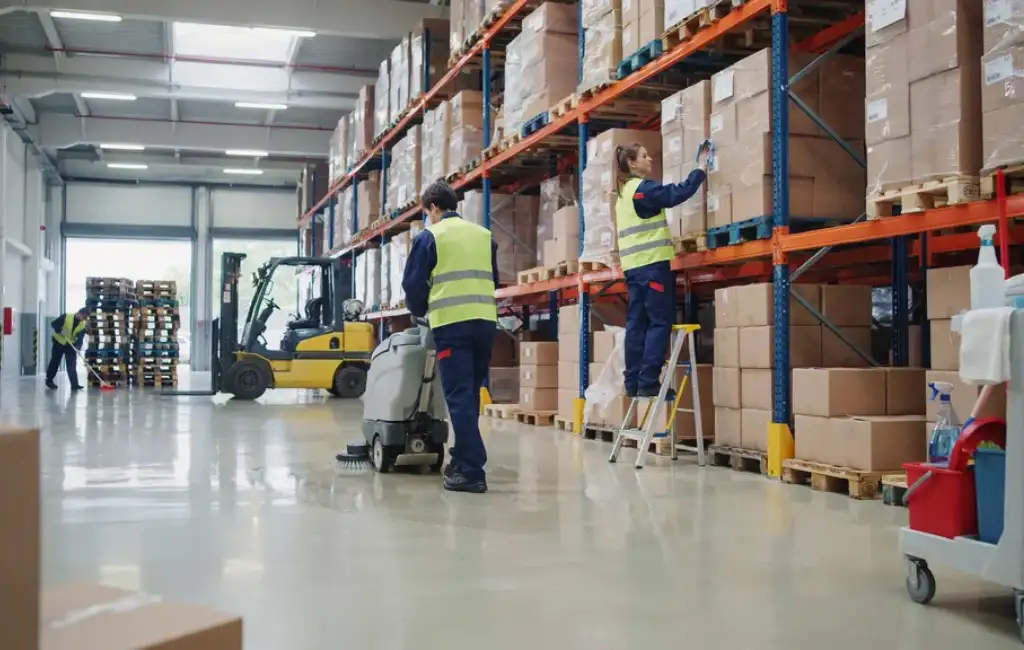
The single biggest operational gap between industrial cleaning and standard commercial janitorial service is not the chemistry or the equipment it is the scheduling. A commercial cleaning crew that arrives at 6 p.m. after the office empties out has no operational complexity to navigate. A cleaning crew working a 300,000 sq. ft. distribution center that runs three shifts, seven days a week, is working inside a live operation where the wrong zone at the wrong time means a wet floor in an active forklift lane.
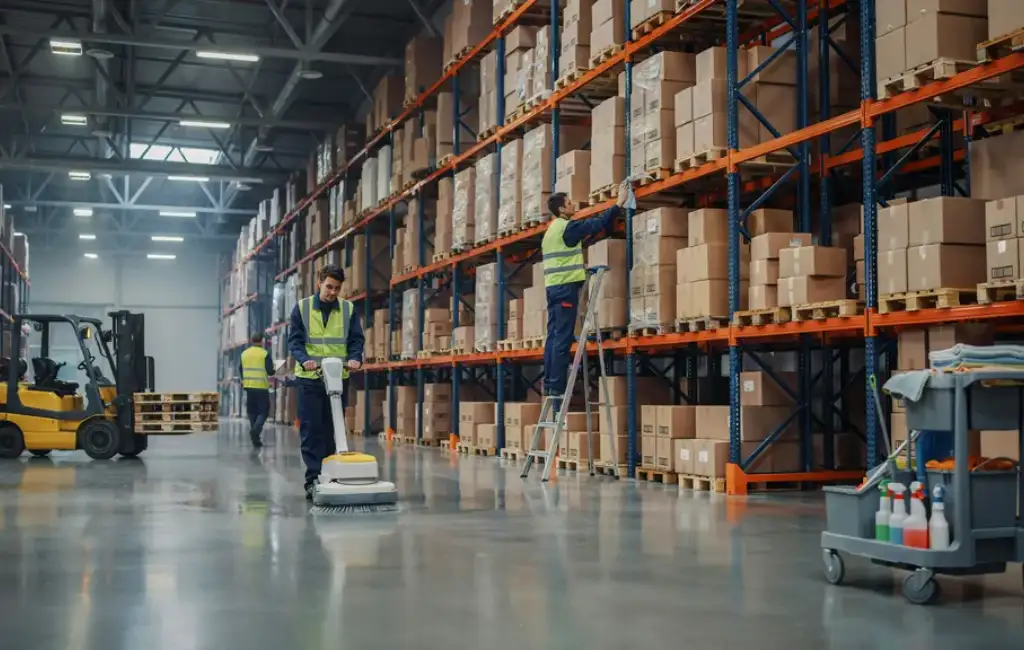
Commercial industrial cleaning during production requires the vendor to understand your facility’s operating rhythm as well as your own team does. That means knowing which zones are active during which shift windows, where forklift traffic peaks, when inbound and outbound freight moves, and how to sequence cleaning work around those realities without requiring your operations manager to babysit the crew.
The process for building a shift-integrated cleaning program for a 24/7 facility typically follows this sequence:
- Facility walk-through to map zones, floor types, ceiling heights, access constraints, and operational hours by area.
- Review of the facility’s shift schedule, production windows, and freight movement patterns with the operations or facilities team.
- Zone assignment each area of the facility is assigned to a specific shift window based on when it is most accessible and least active.
- Crew handoff coordination for multi-shift cleaning programs, supervisor-level communication protocols are established between the cleaning team and the night-shift or weekend operations supervisors.
- Performance verification cleaning completion is logged by zone and time, giving facility management visibility without requiring direct supervision.
What Should Warehouse and Industrial Floor Cleaning Include?
The scope of warehouse floor cleaning and degreasing varies significantly depending on floor type, soil category, and facility use. Buyers who receive proposals that list “floor cleaning” as a single line item without further specification are receiving a proposal that was not written for their facility. A credible industrial cleaning proposal breaks floor cleaning into distinct scopes because bare concrete, sealed concrete, industrial epoxy flooring, and quarry tile all require different chemistry, different equipment settings, and different post-clean protocols.
The table below outlines recommended cleaning approaches by floor type.
| Floor Type | Recommended Cleaning Approach |
|---|---|
| Bare concrete | Ride-on scrubber with appropriate alkaline chemistry; degreaser applied to heavily soiled zones before scrubbing pass |
| Sealed concrete | pH-neutral or mildly alkaline chemistry to avoid degrading the sealer; single scrubber pass with clean water rinse |
| Epoxy-coated floor | pH-neutral chemistry only; no solvent-based degreasers; soft-bristle scrubber heads to protect surface integrity |
| Quarry tile (food facilities) | Food-safe sanitizing chemistry; grout line agitation; separate drain cleaning protocol |
| Rubber / anti-fatigue mat zones | Hand-clean or low-speed scrubber; mats removed, cleaned separately, and reinstalled after floor dries |
Which Chicago-Area Industrial Corridors Does This Pricing Apply To?
Warehouse cleaning prices in Barrington IL are relevant beyond the municipality itself. The Barrington area sits at the intersection of Cook and Lake counties, approximately 35 miles northwest of Chicago’s Loop which means facility managers in Palatine, Hoffman Estates, Schaumburg, Lake Zurich, Streamwood, and Elgin are all operating in the same regional market, facing the same labor cost structures, the same OSHA compliance environment, and the same vendor pool.
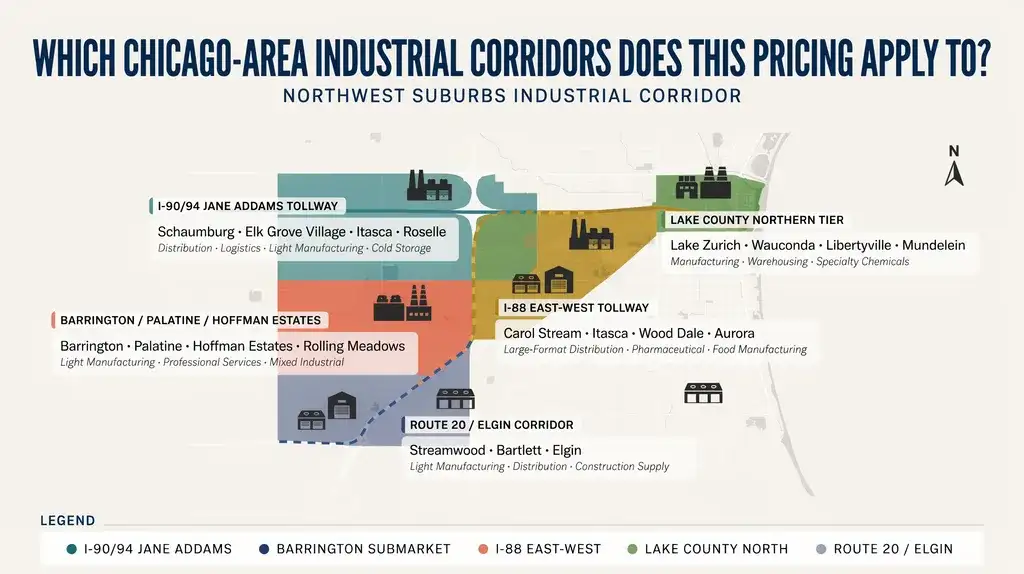
Understanding which industrial submarket your facility sits in matters for pricing context because labor market conditions, facility access logistics, and local competitive density all affect what vendors charge. A 100,000 sq. ft. warehouse in Barrington and an identical facility in Elk Grove Village may receive different quotes from the same vendor for legitimate reasons and knowing your submarket helps you evaluate whether that difference is justified.
| Northwest Suburbs Industrial Corridor | Key Communities | Primary Industry Types |
|---|---|---|
| I-90/94 Jane Addams Tollway | Schaumburg, Elk Grove Village, Itasca, Roselle | Distribution, logistics, light manufacturing, cold storage |
| Barrington / Palatine / Hoffman Estates submarket | Barrington, Palatine, Hoffman Estates, Rolling Meadows | Light manufacturing, professional services, mixed industrial |
| I-88 East-West Tollway | Carol Stream, Itasca, Wood Dale, Aurora | Large-format distribution, pharmaceutical, food manufacturing |
| Lake County northern tier | Lake Zurich, Wauconda, Libertyville, Mundelein | Manufacturing, warehousing, specialty chemicals |
| Route 20 / Elgin corridor | Streamwood, Bartlett, Elgin | Light manufacturing, distribution, construction supply |
How Do You Get an Accurate Industrial Cleaning Quote for a Northwest Suburbs Warehouse?
The most reliable path to an accurate quote for warehouse cleaning services in the Northwest Suburbs is a direct facility assessment: a walk-through with a vendor who maps your zones, evaluates your soil conditions, asks about your shift schedule, and builds a scope around what your facility actually requires. Published price ranges are useful for setting a budget expectation before that conversation. They are not a substitute for it.
The gap between a generic quote and a scoped proposal is where most vendor relationships break down. A vendor who quotes your facility based on square footage alone has not priced your LOTO coordination requirements, your combustible dust overhead surfaces, your epoxy floor maintenance protocol, or your overnight cleaning window. You will discover those gaps either in the contract negotiation or more expensively after the first month of service.
Before you request your first industrial cleaning proposal, prepare the following reference information:
- Total square footage by area (floor space, mezzanine levels, dock zones, office and break room areas).
- Floor type by zone bare concrete, sealed concrete, epoxy, quarry tile, or combination.
- Current soil conditions and known problem areas: grease zones, combustible dust accumulation, embedded staining.
- Operating hours and shift structure single shift, double shift, 24/7, or variable by day of week.
- Active compliance requirements: OSHA programs in place, FSMA or food safety audit schedule, combustible dust assessment status.
- Preferred service frequency and contract structure: daily, weekly, monthly, or a combination by scope.
Why Facility Managers in Barrington and the Northwest Suburbs Choose Evergreen Cleaning Group
Finding an industrial cleaning vendor who can quote accurately, show up on schedule, and operate safely inside a working facility is harder than it should be. Evergreen Cleaning Group serves warehouses, distribution centers, food processing facilities, and manufacturing plants across Barrington, Hoffman Estates, Schaumburg, and Palatine with cleaning programs built around each facility’s compliance requirements, floor type, and production schedule not a generic service model copied from a commercial janitorial template.
| What We Offer | What It Means for You |
|---|---|
| Northwest Suburbs regional focus | We know the industrial corridors, facility types, and operational realities of the Barrington-to-Schaumburg market not a generic Chicago service area that treats your facility as a number in a route |
| Custom facility proposals | Every proposal starts with a direct walk-through of your facility. You receive a scoped, chemistry-specific, schedule-aligned cleaning program not a price-per-square-foot estimate built from a square footage form. |
| Shift-based scheduling capability | Cleaning programs are built around your production windows, shift changes, and freight movement not around a 9-to-5 vendor schedule that requires you to pause operations |
| Compliance-integrated cleaning programs | OSHA protocols, combustible dust procedures, and Lockout/Tagout coordination are built into how we work not added as a liability disclaimer after the contract is signed. |
| Industrial chemistry matched to your floor and facility | Degreaser selection, dilution ratios, and application methods are matched to your floor coating type, soil category, and regulatory environment protecting surfaces and supporting your compliance posture |
| Quote-based pricing, no guesswork | Because every facility is different, pricing is based on what your facility actually requires soil level, access constraints, ceiling height, compliance scope not a national average that has nothing to do with your operation |
FAQs
Q: How much does warehouse cleaning cost in the Barrington IL area?
Warehouse cleaning prices in Barrington IL and the Northwest Suburbs typically range from approximately $0.15 to $0.50 or more per square foot, depending on facility type, soil conditions, floor coating, ceiling height, and service frequency. A dry goods distribution center on a recurring maintenance schedule prices differently than a food processing facility requiring documented sanitation protocols or a manufacturing plant with combustible dust accumulation on elevated surfaces. The most accurate number for your facility comes from a direct walk-through and scoped proposal, not a published range.
Q: What is the difference between industrial warehouse cleaning and standard commercial janitorial service?
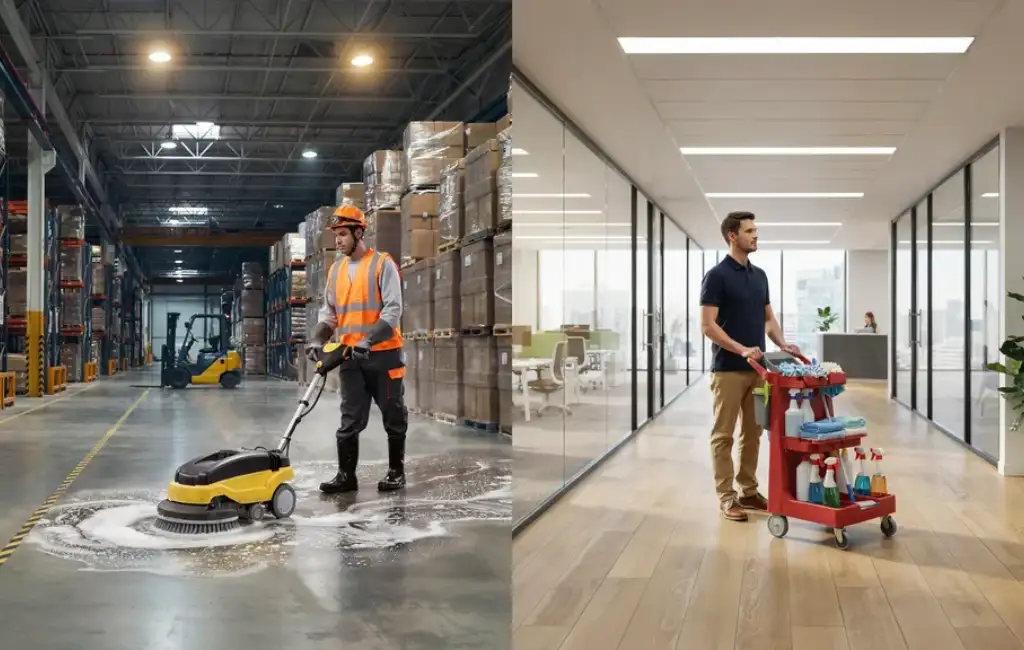
Industrial warehouse cleaning addresses soil types, access challenges, and compliance requirements that standard commercial janitorial services are not built to handle. This includes heavy-duty concrete floor scrubbing and industrial degreasing, combustible dust removal from overhead structural members and racking, OSHA-compliant procedures near active machinery, and facility-specific chemistry matched to floor coating type, soil category, and regulatory environment. A commercial janitorial crew sized and equipped for office buildings is not the right vendor for a 100,000 sq. ft. distribution center or a food processing plant with audit-ready sanitation requirements.
Q: Can your cleaning team work during active production shifts without disrupting operations?
Shift-based and production-integrated cleaning is a standard service model for warehouses and manufacturing plants that run around the clock. Cleaning programs for 24/7 facilities are zone-scheduled around production windows, shift changes, and freight movement so operations are not interrupted and forklift traffic areas are cleaned during designated lulls rather than in conflict with active equipment. The specific sequencing depends on your facility layout, shift structure, and operational priorities, which is why a facility walk-through is the right starting point for any program.
Q: Are your cleaners trained to work in facilities with OSHA combustible dust or food safety requirements?
Industrial cleaning in regulated environments requires more than general cleaning experience it requires awareness of OSHA combustible dust protocols, Lockout/Tagout coordination procedures for work near machinery, and food-safe chemistry and documentation standards for facilities subject to FSMA or internal food safety audits. Facilities with active compliance requirements should ask any vendor directly for documentation of relevant training before a contract is signed.
Q: How do I get an accurate quote for a large warehouse or manufacturing facility in the Northwest Suburbs?
The most useful starting point is a direct facility assessment not a phone estimate based on square footage alone. Before requesting a proposal, it helps to have your approximate floor area and floor coating type identified, your operating hours and shift structure documented, any known problem areas or soil conditions flagged, and your current or anticipated compliance requirements noted, whether that is OSHA, FSMA, food safety audits, or internal EHS standards. A vendor who can walk your facility and return a proposal that addresses scope by zone, chemistry by floor type, and scheduling by your production windows is giving you a number you can actually build a budget around.
Conclusion
If you manage a warehouse, distribution center, or manufacturing plant in Barrington or the Northwest Suburbs, understanding what industrial cleaning actually costs and what drives those costs puts you in a better position before you speak to a single vendor.
Warehouse cleaning prices in Barrington IL are shaped by facility type, soil level, compliance requirements, and shift structure, not by square footage alone which is why a published range is a starting point for budget modeling, not a number to put in a contract. The difference between a dry goods distribution center on a recurring maintenance schedule and a food processing facility requiring documented sanitation protocols is not a rounding error; it is a fundamentally different scope of work with different chemistry, different compliance obligations, and different labor requirements. And choosing a vendor based on price per square foot without understanding what scope sits behind that number is how facilities end up with cleaning programs that do not actually serve their operations.