When something goes wrong in your building, a spill near the entrance, a burned-out bulb in the stairwell, restrooms that need attention before staff arrive, who handles it? And more importantly, have you structured your facility services so the right person is responsible?
Custodial service vs. janitorial service are related but distinct. Custodians typically work on-site during building hours, managing the day-to-day upkeep of a facility as a whole. Janitors are more commonly associated with task-specific cleaning, often performed after hours. The difference matters because choosing the wrong model can leave gaps in your building’s care, your team’s comfort, and your budget.
At Evergreen Cleaning Group, we work with commercial facility managers every day to help them understand exactly what their buildings need and build a cleaning program that actually delivers it.
Here is what this guide covers:
- The precise difference between custodial and janitorial services, including how responsibilities and work schedules differ
- A breakdown of which facility types benefit from each model, including schools, offices, and healthcare buildings
- A practical framework for deciding between in-house custodial staff and contracted janitorial services
- How eco-friendly cleaning practices fit into both service models
- A cost comparison framework to help you forecast and budget accurately
What Is the Difference Between Custodial and Janitorial Services?
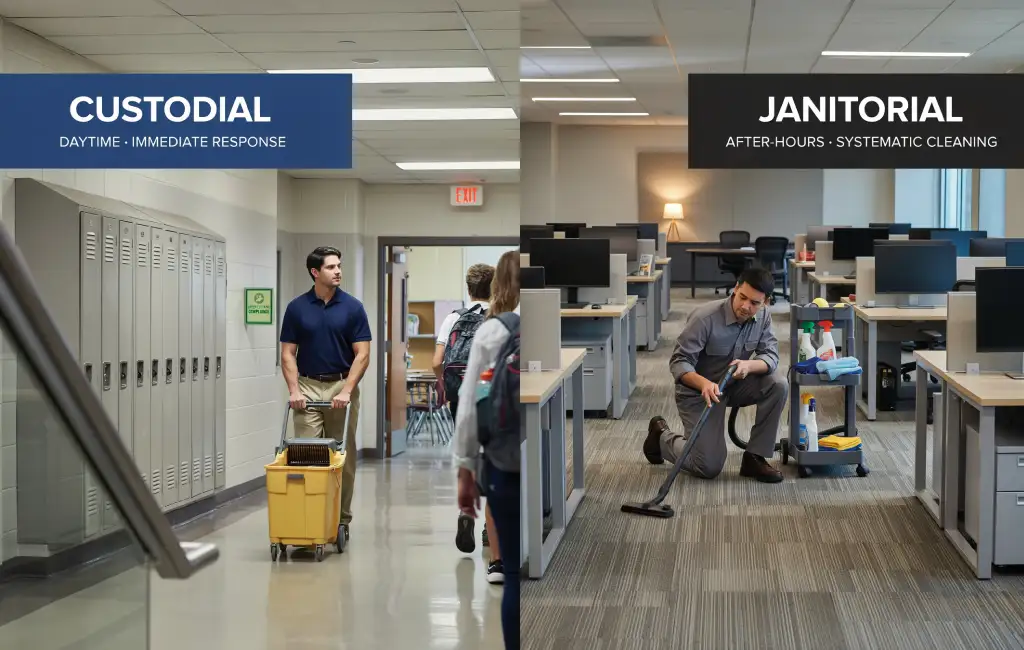
The core distinction comes down to scope and timing. A custodian manages the facility environment on an ongoing basis throughout the day, responding to needs as they arise. A janitor executes a defined set of cleaning tasks, typically after building hours, when occupants are gone. Picture this: at 11 a.m., a custodian notices a spill in the lunchroom and addresses it before the next group arrives. That same room gets a full sanitation cycle from a janitorial crew at 10 p.m. Both contribute to a clean building. Neither role alone covers everything the other does.
The easiest way to separate the two is to ask where the work happens in relation to the building’s occupied hours. Custodial cleaning services are built around presence and responsiveness during the day. Janitorial services for commercial buildings are built around efficiency and thoroughness after hours. Both rely on trained professionals, both use commercial-grade equipment and cleaning products, and both can operate under formal service agreements. But their operational rhythms, task profiles, and staffing structures are genuinely different.
| Custodial Services | Janitorial Services | |
| Typical work hours | During building occupancy | After hours or overnight |
| Primary focus | Ongoing facility stewardship | Scheduled task completion |
| Facility presence | On-site throughout the day | On-site for defined shifts |
| Task type | Reactive and proactive upkeep | Repeatable, measurable cleaning |
| Common settings | Schools, healthcare, institutional | Offices, retail, commercial buildings |
For a thorough overview of how these roles are defined within the broader facilities management industry, the ISSA Cleaning Industry Overview provides useful context on professional standards and scope definitions.
Custodial Services Focus on Ongoing Facility Stewardship
The word “custodian” shares its root with “custody” meaning care, responsibility, and guardianship over an environment. That etymology is a useful anchor. A custodian does not simply clean a building; they are responsible for it during the hours they are on-site. When a restroom runs low on supplies, a custodian restocks it. When a light bulb burns out in a stairwell, a custodian replaces it. When a common area needs a quick wipe-down between meetings, a custodian handles it without waiting for a scheduled cleaning window.
This broader sense of responsibility is what sets custodial work apart from a standard cleaning role. Custodians are present during building hours and respond to facility needs as they arise throughout the day, not just at scheduled intervals. Their scope often extends into light maintenance monitoring HVAC filter conditions, reporting building issues to facility management, and supporting the daily rhythm of an occupied building. That on-call, on-site quality is what institutional facilities pay for when they hire custodial staff.
Janitorial Services Focus on Defined Cleaning Tasks
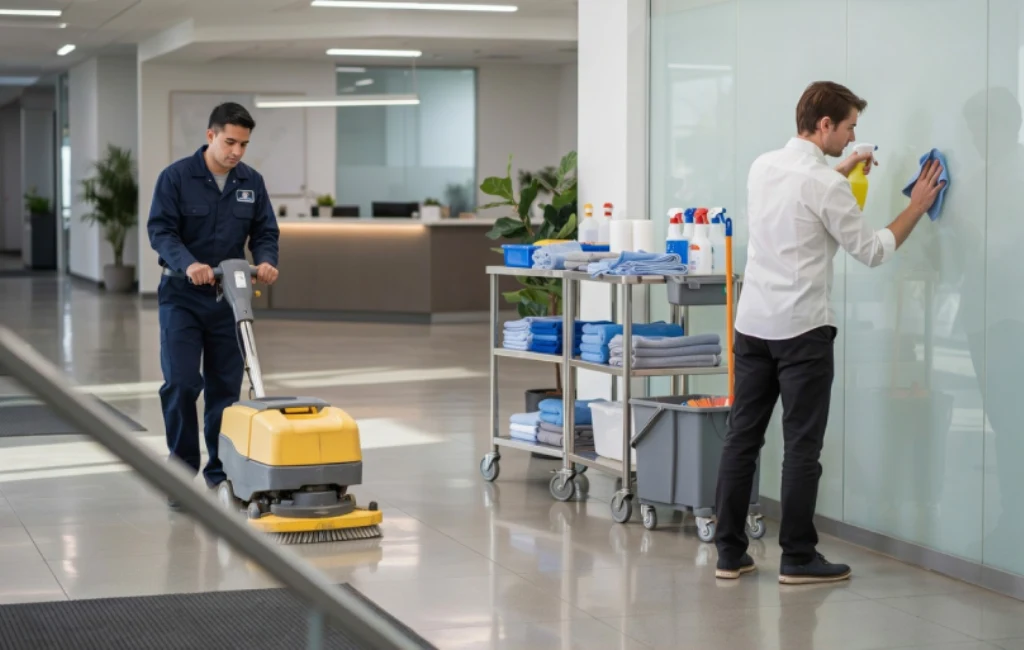
Janitorial cleaning services operate on a different logic. Where custodial work is responsive, janitorial work is systematic. A janitorial crew arrives with a scope of work floors to sweep and mop, restrooms to sanitize, trash to remove, surfaces to disinfect and works through it within a defined shift. The goal is consistency and completeness, not real-time responsiveness.
Because janitorial crews typically work after hours, they rarely interact with building occupants. This has practical implications for access management, security protocols, and communication. It also means that any facility need that arises during the business day falls outside the janitorial scope by design. That is not a flaw in the model it is simply how the model is structured. Understanding this boundary is what allows facility managers to build cleaning coverage that is actually complete rather than accidentally leaving gaps between roles.
What Do Custodians Actually Do? A Full Breakdown of Custodian Responsibilities
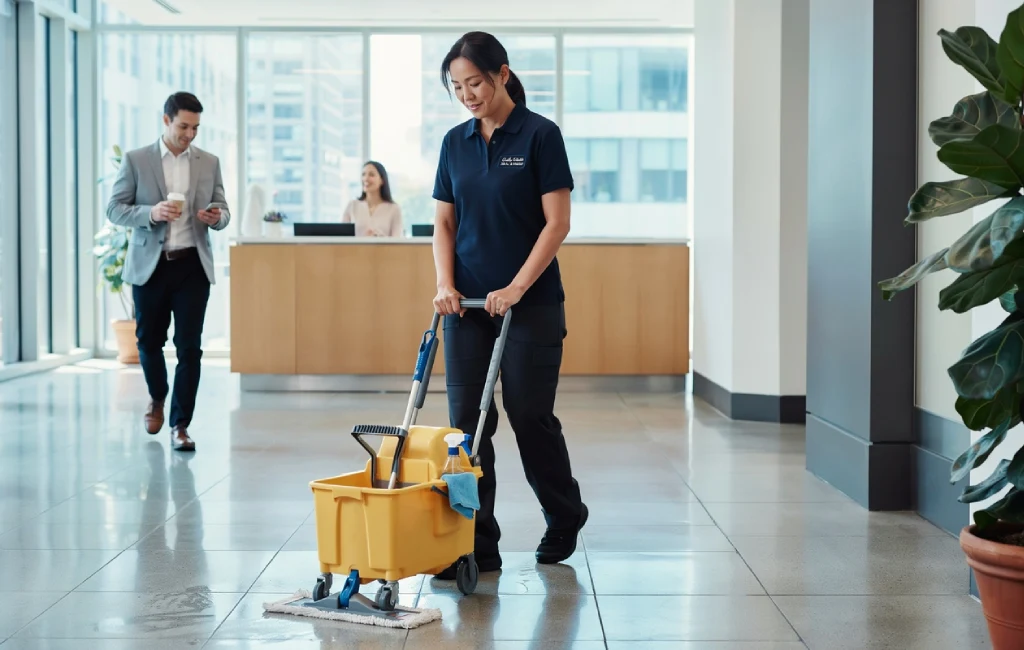
Custodian responsibilities span two distinct categories: core daily cleaning tasks and extended facility responsibilities that go beyond what most people associate with a cleaning role. In a K-12 school, a custodian’s day might start before the first bell with restroom checks, move through lunchroom cleanup and hallway maintenance, and end with an equipment check and supply inventory after dismissal. In a corporate office, the same custodial role might focus more on common area upkeep, lobby presentation, and conference room resets. The setting shapes the daily rhythm, but the underlying scope is consistently broader than a scheduled cleaning checklist.
This is the most commonly misunderstood aspect of the custodial role. Facility managers who think of custodians as daytime janitors tend to underutilize them or worse, under-specify the role and then wonder why building upkeep feels fragmented. A well-defined custodial position covers both the cleaning and the stewardship functions that keep a building functional and presentable throughout occupied hours.
Core Daily Tasks:
- Sweeping, mopping, and spot-cleaning high-traffic floors
- Restroom checks and restocking of paper products and soap dispensers
- Trash collection and recycling bin management in common areas
- Wiping down common surfaces, door handles, and touch points
- Lobby and entrance maintenance throughout the day
- Responding to spills, accidents, and unplanned cleaning needs
- Conference room and common area resets between uses
Extended Facility Responsibilities:
- Changing light bulbs and reporting electrical issues to facility management
- Monitoring and replacing HVAC filters on a scheduled basis
- Tracking and ordering cleaning supply inventory
- Setting up and breaking down rooms or spaces for events
- Flagging maintenance issues plumbing, hardware, HVAC anomalies for appropriate follow-up
- Supporting building security by monitoring access and unusual activity during the day
The U.S. Bureau of Labor Statistics Occupational Outlook for Janitors and Building Cleaners provides context on the full scope of duties common across both custodial and janitorial roles at a national level.
Custodians Handle Both Cleaning and Light Building Maintenance
The dual nature of the custodial role part cleaner, part building steward is what makes it particularly valuable in institutional settings where a full facilities management team is not available on-site at all times. Beyond routine cleaning, custodians may change HVAC filters, replace light bulbs, coordinate minor repairs, and flag building issues to facility management. These are not incidental tasks; they are a core part of what the role is designed to cover.
This overlap with light maintenance tasks also means that the scope of a custodial position should always be defined in writing. Without a clear job description or service agreement, it becomes unclear what the custodian is responsible for versus what should escalate to a contractor or facilities team. That ambiguity can create liability gaps, service failures, and staff frustration that a well-drafted scope of work would prevent.
Custodians Support Daytime Operations in Ways Janitors Cannot
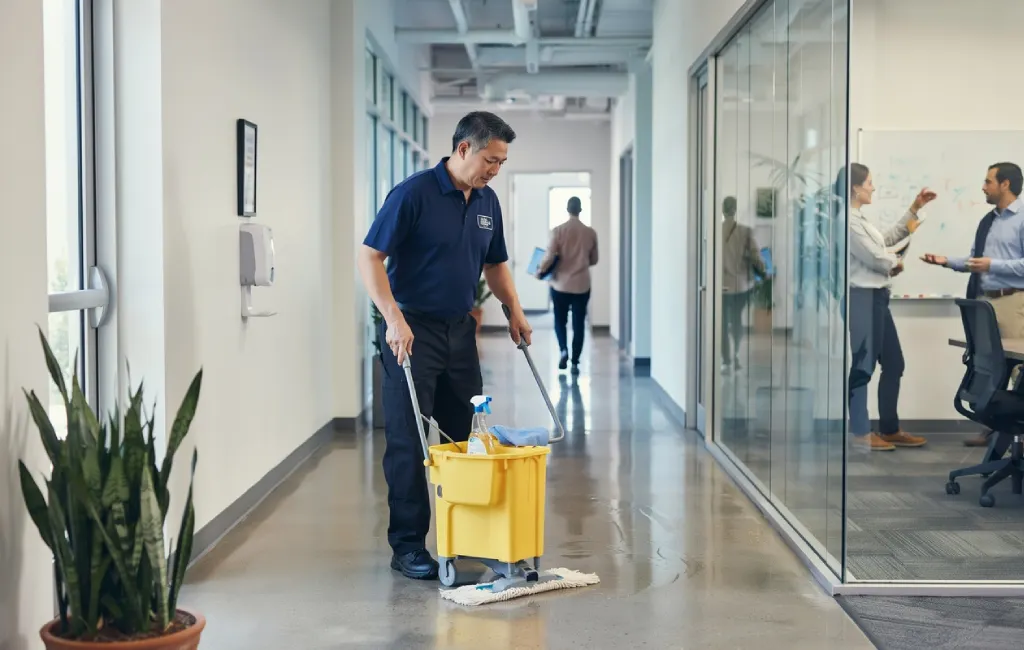
The structural advantage of a custodial model is timing. When an issue arises during the business day a restroom out of order, a spill in the lobby, a supply shortage in a break room a custodian can respond immediately. A janitorial crew scheduled for 10 p.m. cannot. That gap between the problem and the response is not abstract; it affects how the building feels to the people working in it, and it creates real liability exposure for facility managers.
Daytime facility support reduces that exposure and improves occupant satisfaction in ways that after-hours cleaning structurally cannot replicate. For schools, medical offices, and customer-facing commercial spaces, the value of immediate, responsive facility care is often worth the additional staffing investment. The question is not whether daytime coverage is valuable it is whether your facility’s operational profile justifies that investment relative to a contracted after-hours model.
What Do Janitors Do? A Full Breakdown of Janitorial Duties
Janitor duties are defined by their task-based, schedule-driven structure. A professional janitorial service does not respond to the building as the day unfolds; it executes a specific scope of work within a specific window, typically overnight or in the early morning hours before occupants arrive. This structure is not a limitation it is a design feature that makes janitorial services measurable, repeatable, and easy to audit against a service level agreement.
For commercial facility managers, that measurability is a significant operational advantage. When you contract a janitorial service, you know exactly which tasks are being performed, at what frequency, and to what standard. You can evaluate performance against a defined checklist. You can adjust scope when your facility needs change. You cannot do any of that with a loosely defined in-house arrangement. Professional janitorial services operate under formal service level agreements (SLAs) and cleaning checklists that provide the accountability and consistency that informal arrangements consistently fail to deliver.
The following matrix shows how standard janitorial tasks are typically distributed across service frequencies:
| Task | Nightly | Weekly | Monthly |
| Floor sweeping and mopping | X | ||
| Restroom sanitation | X | ||
| Trash and recycling removal | X | ||
| Surface disinfecting (desks, counters) | X | ||
| Interior window and glass cleaning | X | ||
| Carpet vacuuming | X | ||
| Carpet extraction (deep clean) | X | ||
| Floor stripping and waxing | X | ||
| High dusting (vents, ledges) | X |
For reference on cleaning industry task standards and service agreement benchmarks, the Building Service Contractors Association International (BSCAI) publishes resources on janitorial service scope and industry best practices.
Janitorial Services Are Built Around Scheduled, Measurable Cleaning
The defining characteristic of contracted janitorial services is their accountability structure. A janitorial contract defines exactly which tasks are completed, at what frequency, and to what standard giving facility managers a clear scope of work they can audit and enforce. This is fundamentally different from an informal in-house cleaning arrangement where expectations are often implicit and accountability is difficult to formalize.
This predictability is particularly valuable for multi-tenant buildings, retail centers, and corporate campuses where cleaning checklists and consistent results directly affect tenant satisfaction and, ultimately, lease retention. Tenants notice when common areas are not maintained to standard. Property managers feel that feedback quickly. A professional janitorial contract with documented performance standards gives the facility manager a tool to address those concerns before they become a tenant relations problem.
Professional janitorial companies also carry general liability insurance and workers’ compensation coverage, transferring risk that in-house staffing arrangements place directly on the employer.
After-Hours Janitorial Cleaning Minimizes Disruption to Your Business
After-hours cleaning solves a real operational problem: how do you maintain a clean, sanitary building without disrupting the people working in it? When a janitorial crew works the overnight shift, there are no vacuums running during conference calls, no mop buckets blocking corridors during peak foot traffic, and no chemical odors lingering when occupants arrive. The building is simply ready when the workday begins.
For healthcare facilities, legal offices, and financial services environments where confidentiality and uninterrupted workflow are priorities, this scheduling model is not just a convenience it is a structural requirement. Cleaning staff working in sensitive spaces after hours also need documented security protocols for key and access management. Facility managers should confirm that any contracted janitorial provider has these protocols in writing before access is granted to the building.
Which Facility Types Need Custodial Services vs. Janitorial Services?
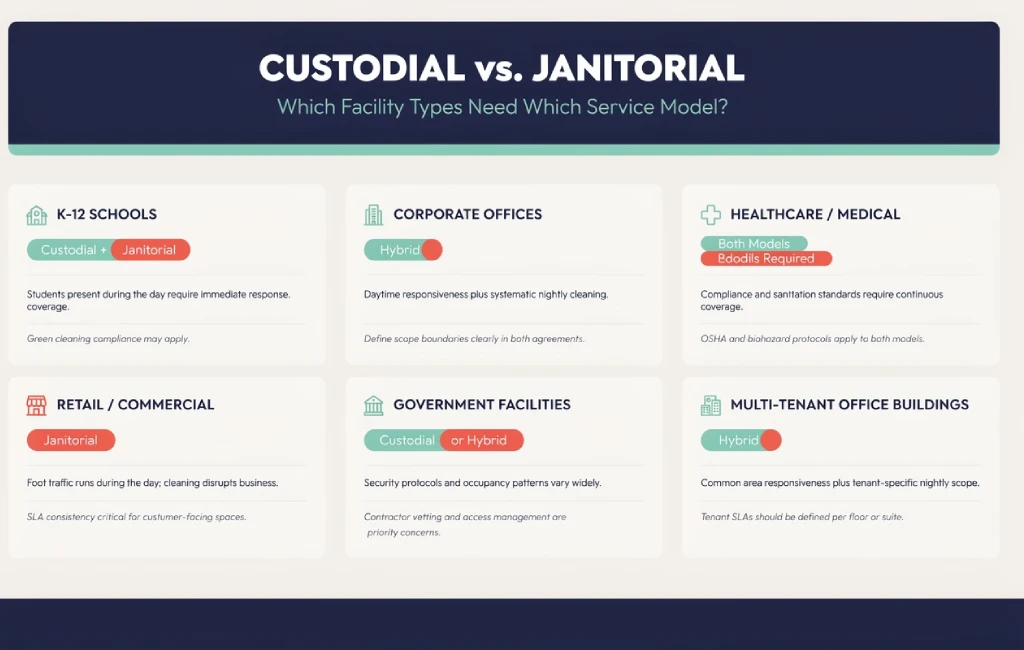
The right cleaning model depends heavily on how your facility operates its occupancy schedule, who uses the space, and what compliance obligations apply. A K-12 school where a custodian responds to a gym floor cleaning spill during third period is a fundamentally different operational picture from a law firm office building where a janitorial crew sanitizes common areas at midnight. The physical cleaning tasks may overlap. The service model that supports them does not.
Facility maintenance roles are not one-size-fits-all, and the best answer for your building is almost always grounded in your specific facility type, occupancy pattern, and the regulatory environment your operations sit within. The table below maps common facility types to recommended service models.
| Facility Type | Recommended Model | Reason | Key Consideration |
| K-12 schools | Custodial (daytime) + janitorial (breaks) | Students present during the day require immediate response | Green cleaning compliance may apply |
| Corporate offices | Hybrid (porter + after-hours janitorial) | Daytime responsiveness + systematic nightly cleaning | Define scope boundaries clearly in both agreements |
| Healthcare / medical | Custodial + contracted janitorial (both) | Compliance and sanitation standards require continuous coverage | OSHA and biohazard protocols apply to both models |
| Retail / commercial | Janitorial (after-hours) | Foot traffic and operations run during day; cleaning disrupts business | SLA consistency critical for customer-facing spaces |
| Government facilities | Custodial or hybrid | Security protocols and occupancy patterns vary widely | Contractor vetting and access management are priority concerns |
| Multi-tenant office buildings | Hybrid | Common area responsiveness + tenant-specific nightly scope | Tenant SLAs should be defined per floor or suite |
Schools and Educational Facilities Typically Rely on Custodial Staff
Schools represent the clearest archetype for the custodial model. The building is occupied by students and staff for most of the day, incidents that require immediate cleaning response are frequent and unpredictable, and the consequences of a delayed response a wet hallway floor, an unsanitary restroom during the lunch period are immediate and visible. A janitorial crew scheduled for 9 p.m. cannot meet those needs.
Custodian responsibilities in schools and offices also carry compliance implications that do not apply to most commercial cleaning contexts. Educational facilities in several states are subject to specific regulations around cleaning products used in the presence of children, making green cleaning practices especially relevant in this setting. California’s Healthy Schools Act, for example, establishes notification and restricted-chemical requirements for school cleaning programs.
Many districts supplement their on-site custodial staff with contracted janitorial services for deep cleaning during school breaks spring recess, summer, and winter closures. This hybrid model gives schools the daytime responsiveness they need during the school year and the thorough, scheduled deep cleaning that a summer break makes possible.
Commercial Office Buildings Often Use Both Models Together
For most mid-size to large commercial office buildings, the honest answer is that neither model alone is sufficient. A daytime porter or light custodial presence handles real-time needs, lobby presentation, conference room resets, restroom checks, spill response, while a contracted janitorial crew handles the full nightly cleaning cycle. This hybrid approach is the standard operating model for office buildings that need both responsiveness and thoroughness.
The hybrid model works precisely because the two roles complement rather than duplicate each other. The custodial presence ensures the building is functional and presentable during occupied hours. The janitorial crew ensures it meets a consistent sanitation standard every morning. The key to making this work operationally is defining clear scope boundaries between the roles in writing in both the custodial job description and the janitorial service agreement to prevent task overlap, accountability gaps, and billing disputes.
Healthcare Facilities Require Compliance-Driven Cleaning in Both Models
Healthcare environments raise the stakes on every dimension of facility cleaning. Whether a medical facility uses in-house custodial staff or contracted janitorial services, the cleaning protocols must meet OSHA standards for chemical handling, biohazard management, and personal protective equipment use.
Healthcare cleaning requires specialized training and, in some settings, documented certification that a general commercial cleaning contractor may not be able to provide. Best cleaning services for institutional facilities in the healthcare category are distinguished not just by what they clean, but by how they can prove they clean it correctly through training records, safety data sheets, and references from comparable healthcare accounts. Facility managers in medical settings should request all three before a contract is signed. The consequences of a compliance gap in a healthcare facility, an OSHA violation, an infection control incident, a biohazard handling failure make vendor selection in this context one of the highest-stakes procurement decisions a facility manager makes.
Should You Hire an In-House Custodian or Contract a Janitorial Service?
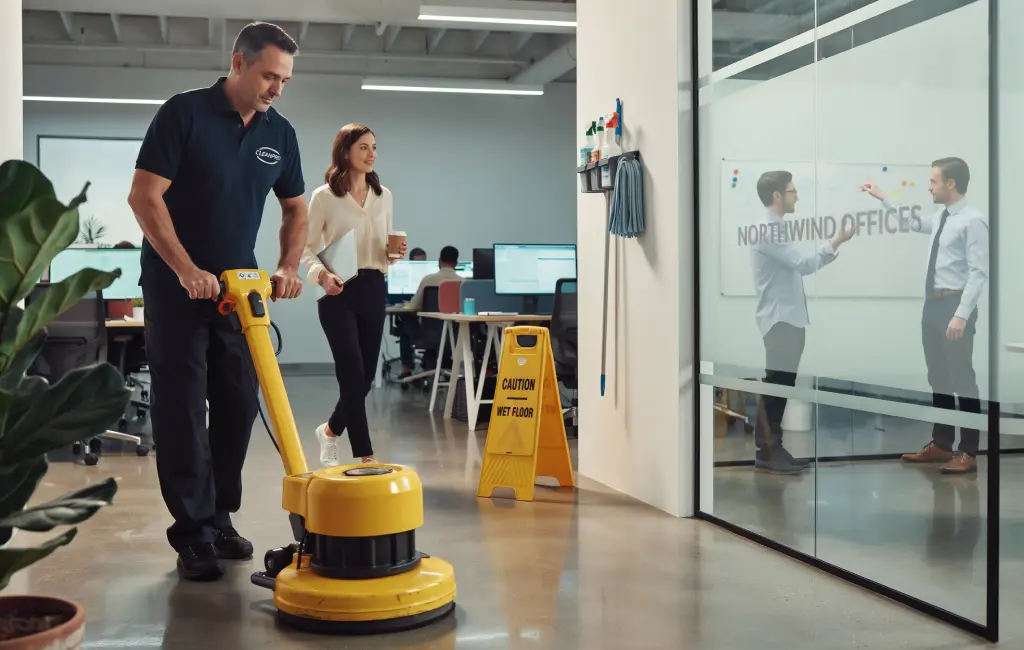
This is the question most facility managers are actually asking when they search the custodial vs. janitorial distinction. The definitional difference matters, but the operational decision who employs the people cleaning your building, and under what structure is where the real consequences live. Both models work in the right context. Neither is universally superior. What matters is which one fits your facility’s size, occupancy schedule, compliance environment, and budget.
Choosing between in-house custodian or contracted janitorial is a genuine decision framework question, and it deserves a direct answer rather than a vague “it depends.” The table below lays out the key factors.
| Decision Factor | In-House Custodian | Contracted Janitorial |
| Upfront cost | Lower (just hiring costs) | May include onboarding or setup fees |
| Ongoing HR burden | High payroll, benefits, training, replacement | Low managed by the contractor |
| Schedule flexibility | Limited by employment terms | Built into the service agreement |
| Compliance responsibility | Employer bears full OSHA and labor liability | Shared or transferred to contractor |
| Staff replacement | Facility manager’s problem | Contractor’s responsibility |
| Service consistency | Depends on individual performance | Enforced by SLA and account management |
| Access to specialty services | Requires separate hiring or contracting | Often bundled or available on request |
For context on how commercial cleaning employment and contracting structures are categorized nationally, the U.S. Department of Labour’s guidance on contractor vs. employee classification is a useful reference when evaluating the employment model implications of in-house custodial staffing.
In-House Custodians Offer Presence but Come with HR Overhead
Employing a custodian means taking on payroll, benefits, workers’ compensation insurance, training, scheduling, and replacement coverage when staff are out. These costs are real and they add up quickly often to a total that surprises facility managers who compare a custodian’s hourly wage directly against a janitorial contract price without accounting for the full employment overhead.
There is genuine operational value in an in-house custodian that should not be dismissed. A long-tenured custodian develops real familiarity with a building’s specific quirks, tenant relationships, and maintenance history. That institutional knowledge has practical value in large campuses or security-sensitive facilities where staff continuity matters and where a rotating contractor crew creates real access management concerns. The question is whether that value justifies the HR and administrative overhead that comes with direct employment and for most small to mid-size commercial facilities, the math usually does not favor it.
Contracted Janitorial Services Offer Flexibility, Accountability, and Scalability
A contracted janitorial provider assumes responsibility for staffing, training, compliance, and equipment, removing the administrative burden from the facility manager entirely. You do not manage the cleaning team’s schedule, handle their workers’ compensation claim, or find a replacement when someone calls out. The contractor handles all of that. What you manage is the service agreement, which defines exactly what you are getting and provides formal recourse if it is not delivered.
Contracted services also scale in ways that an employment arrangement cannot. If you need to add a deep-clean cycle before a major event, reduce scope during a low-occupancy quarter, or expand coverage to an additional floor, those adjustments happen through the service agreement rather than through a hiring or termination process. Operational efficiency is one of the clearest advantages of the contracted model, your facility’s cleaning coverage adapts to your building’s actual needs rather than being locked into a fixed staffing structure. Service level agreements hold the contractor accountable in writing, with documented performance standards and a formal mechanism for addressing failures that an internal custodial arrangement rarely formalizes.

Why Evergreen Cleaning Group Is the Right Choice for Your Commercial Facility
When you are selecting a commercial cleaning partner, the difference between a provider who shows up and a provider who performs consistently comes down to how well their program is built around your facility. Evergreen Cleaning Group works with commercial clients to design cleaning programs that reflect how their buildings actually operate, not a generic package applied the same way regardless of building type, occupancy schedule, or compliance requirements.
| What We Offer | What It Means for You |
| Eco-friendly cleaning protocols | Your facility is cleaned with products that protect occupant health and support your sustainability goals |
| Bonded and insured cleaning professionals | You are protected against liability from property damage or workplace incidents during cleaning operations |
| Custom scope of work for every facility | You are not paying for services your building does not need, and nothing required falls through the cracks |
| Consistent, named cleaning teams | You know who is in your building, and your cleaning team knows your facility, no revolving door of unfamiliar contractors |
| Flexible scheduling including after-hours service | Your operations are never disrupted, and your building is ready for occupants every morning |
| No-obligation facility assessment before any contract | You get a cleaning plan built around your actual space before you commit to anything |
- Evergreen Cleaning Group designs every cleaning program around your facility’s specific layout, occupancy schedule, and compliance requirements, so the scope reflects what your building needs, not what is easiest to deliver.
- Our team is trained in both daytime custodial support and contracted after-hours janitorial operations, which means we can manage a full hybrid cleaning model under a single service agreement rather than requiring you to coordinate multiple vendors.
- We use eco-conscious cleaning products and protocols appropriate for sensitive environments, including medical offices, schools, and facilities with indoor air quality standards, so your cleaning program supports your occupants, not just your floors.
Evergreen Cleaning Group serves commercial facilities with a team of trained, bonded, and insured cleaning professionals who bring both custodial expertise and contracted janitorial discipline to every account. Whether you manage a single-tenant office, a multi-floor commercial building, or a regulated institutional facility, we are ready to assess your needs, answer your questions, and build a cleaning program that performs day after day.
Frequently Asked Questions
Q: Is a custodian the same as a janitor?
Not exactly. Both roles involve cleaning, but a custodian typically works during building hours and takes ongoing responsibility for the facility environment, responding to issues as they arise, restocking supplies, and performing light maintenance. A janitor is more commonly associated with scheduled, task-based cleaning completed after hours or outside of occupancy times. In practice the terms are sometimes used interchangeably, but the distinction matters when you are structuring your facility’s cleaning coverage.
Q: What tasks does a custodian do that a janitor does not?
Custodians often handle tasks that go beyond cleaning to include light building maintenance: changing light bulbs, monitoring and replacing HVAC filters, managing supply inventories, supporting event setups and takedowns, and flagging facility issues to management in real time. Janitors typically focus on a defined cleaning checklist, floors, restrooms, trash, surfaces, completed within a scheduled shift. The custodial role is broader in scope and requires more direct interaction with the building’s occupants and systems throughout the day.
Q: Should I hire an in-house custodian or outsource to a janitorial service?
It depends on your facility’s size, budget, and operational needs. In-house custodians offer daytime presence and building familiarity but require you to manage payroll, benefits, training, insurance, and replacement coverage, costs that add up well beyond a base hourly wage. Contracted janitorial services bundle labor, materials, compliance, and management into a single agreement with built-in accountability. For most small to mid-size commercial facilities, contracted services offer better janitorial service cost predictability and significantly less administrative burden than direct employment.
Q: How much does custodial service cost compared to janitorial service?
Pricing varies significantly by facility size, service frequency, scope of work, and geographic market. In-house custodial employment carries a full cost load including wages, payroll taxes, benefits, equipment, and supply procurement a total that is frequently underestimated when comparing it against contractor bids. Contracted janitorial services are typically priced per visit or on a monthly retainer driven by square footage, restroom count, and task scope. Requesting an itemized scope of work from any vendor you are evaluating is the most accurate way to compare options on equal footing.
Q: Do schools need custodial services or janitorial services?
Most schools rely on in-house custodial staff during the school day because immediate, responsive facility care is essential in a student-occupied building a spill, a restroom issue, or a supply shortage cannot wait until 10 p.m. After-hours or weekend deep cleaning is often handled by a contracted janitorial service, creating a hybrid model that many districts use effectively. In states with green cleaning mandates for educational facilities, the products and protocols used in schools by either role must also meet specific safety standards.
Conclusion
Once you understand the difference between custodial and janitorial services, the more useful question becomes clear: what does your specific facility need, and how do you build a cleaning program that actually delivers it?
Custodians and janitors serve different operational functions custodians manage the facility environment during occupied hours, while janitorial crews complete scheduled cleaning tasks after hours and mixing up those roles leaves gaps in your building’s coverage. The right service model depends on your facility type, occupancy schedule, and compliance requirements, with many commercial buildings benefiting most from a hybrid approach that combines both. Contracted janitorial services provide the accountability, scalability, and compliance infrastructure that in-house arrangements rarely match, making them a cost-effective and operationally sound choice for most commercial facilities.
You should not have to figure out the right model alone, and you should not sign a cleaning contract before someone has walked your building and understood how it actually operates. That is exactly where a facility assessment makes the difference.
Evergreen Cleaning Group is ready to help you build a cleaning program that fits your space, your schedule, and your standards. Contact us today to schedule your free facility assessment and get a custom cleaning plan with no obligation.