If you manage an Illinois office, you have probably handed a cleaning contract to a vendor and then quietly wondered later whether everything was actually getting done. The trash got emptied. The restrooms looked fine at a glance. But were the door handles disinfected? Were the air vents dusted? Was the elevator floor mopped after the last muddy Illinois winter morning?
A professional office cleaning service in Illinois should cover a structured set of daily tasks, weekly duties, and periodic deep-cleaning services, tailored to your facility type, foot traffic, and the specific demands of operating in this state. The standard scope goes well beyond emptying wastebaskets, and knowing exactly what should be included gives you the clarity to hold any vendor accountable.
At Evergreen Cleaning Group – Commercial Cleaning & Janitorial Services, we work with Illinois businesses across a range of commercial environments, and this guide reflects what a genuinely complete cleaning scope looks like in practice.
Here is what this guide covers:
- The full list of daily janitorial duties every Illinois office should expect from a professional cleaning service
- Weekly and periodic tasks that protect your facility’s appearance, air quality, and long-term condition
- Restroom sanitation and high-touch surface disinfection standards, including current best practices for shared workspaces
- How to tell the difference between routine maintenance cleaning and deep cleaning, and when each is appropriate
- A practical framework for evaluating whether your commercial cleaning vendor is actually delivering
What Does a Standard Commercial Office Cleaning Service Actually Cover?
A Commercial Cleaning Service in Barrington, Illinois is not a single service. It is a tiered system of recurring cleaning tasks, each performed at a different frequency and designed to serve a specific purpose. Many commercial cleaning contracts bundle these tasks under one generic label, which often creates a gap between what a client expects and what the cleaning provider actually delivers.
The three tiers that a professional service scope should address are daily maintenance, weekly care, and periodic deep cleaning. Daily maintenance keeps the facility functional and hygienic between full-service visits. Weekly care addresses the surfaces, spaces, and systems that accumulate wear faster than a single workday allows. Periodic deep cleaning resets the baseline so that routine maintenance can maintain it effectively.
| Service Tier | What It Covers |
|---|---|
| Daily Maintenance | Trash removal, restroom sanitation, high-touch surface disinfection, floor sweeping and mopping in high-traffic areas, drinking fountain cleaning |
| Weekly Care | Full carpet vacuuming, dusting of furniture and air vents, conference room cleaning, glass and mirror cleaning, elevator mopping, recycling removal |
| Periodic Deep Cleaning | Appliance interiors, grout scrubbing, furniture undersides, window sill interiors, behind and beneath heavy equipment, chair bases |
What Should Happen Every Day? The Daily Office Cleaning Checklist
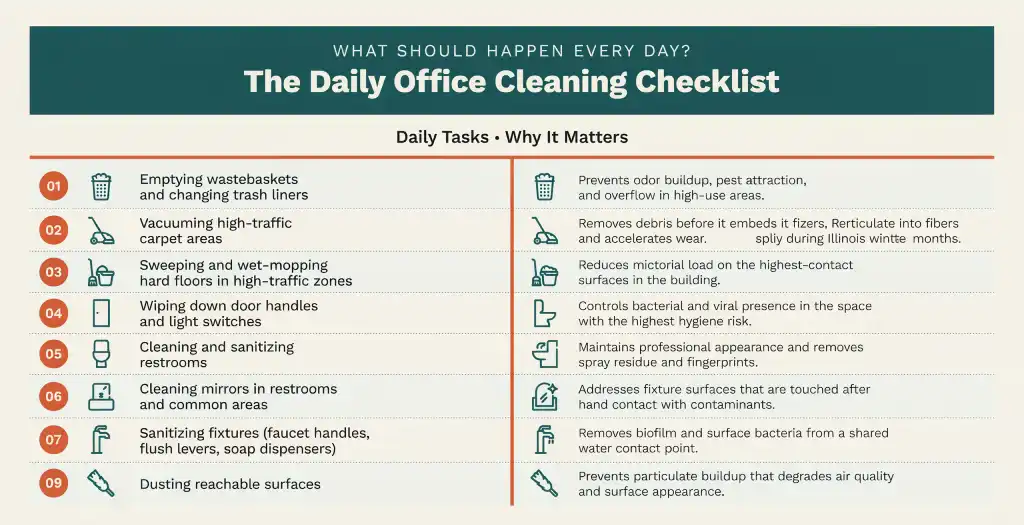
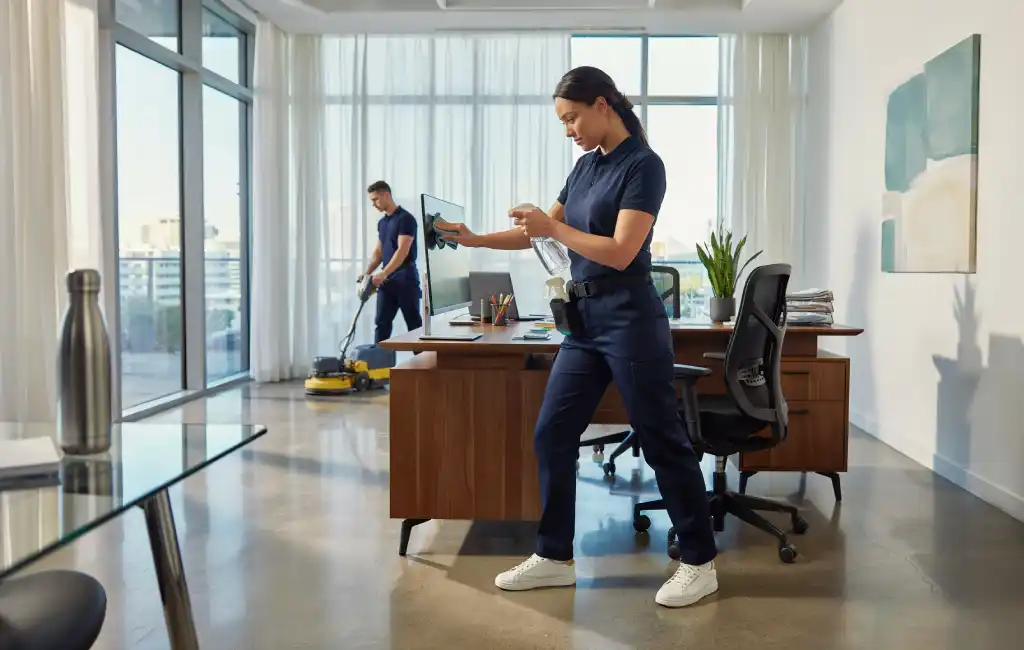
The daily and weekly office cleaning checklist is the backbone of any professional service agreement, and the daily tier is where hygiene is either maintained or quietly allowed to slip. Every visit from a professional cleaning service should cover the following tasks as a baseline. Whether you choose after-hours or daytime office cleaning services in Barrington depends on your facility’s occupancy and operational needs, but either schedule must maintain these same daily standards without exception.
The purpose of daily cleaning is not just appearance. Each task category addresses a specific hygiene or safety function, and understanding why each matters helps you spot when something is being skipped.
| Daily Task | Why It Matters |
|---|---|
| Emptying wastebaskets and changing trash liners | Prevents odor buildup, pest attraction, and overflow in high-use areas |
| Vacuuming high-traffic carpet areas | Removes debris before it embeds into fibers and accelerates wear |
| Sweeping and wet-mopping hard floors in high-traffic zones | Removes particulate and reduces slip hazards, especially during Illinois winter months |
| Wiping down door handles and light switches | Reduces microbial load on the highest-contact surfaces in the building |
| Cleaning and sanitizing restrooms | Controls bacterial and viral presence in the space with the highest hygiene risk |
| Cleaning mirrors in restrooms and common areas | Maintains professional appearance and removes spray residue and fingerprints |
| Sanitizing fixtures (faucet handles, flush levers, soap dispensers) | Addresses fixture surfaces that are touched after hand contact with contaminants |
| Cleaning drinking fountains | Removes biofilm and surface bacteria from a shared water contact point |
| Dusting reachable surfaces | Prevents particulate buildup that degrades air quality and surface appearance |
The CDC’s guidelines on cleaning and disinfecting public spaces provide useful context for understanding which surfaces warrant daily attention in shared commercial environments.
High-Touch Surface Disinfection Is a Daily Job, Not a Weekly One
High-touch surface cleaning is one of the most frequently misunderstood elements of a commercial cleaning scope. Many clients assume disinfection is a periodic task, something done during a deep clean or a quarterly visit. That assumption leaves your employees and visitors exposed every day in between.
Door handles, light switches, elevator buttons, shared telephones, reception desk surfaces, and communal touchscreen modules accumulate bacteria and viral load throughout the workday. Disinfecting them once a week means five or six days of recontamination go unaddressed. EPA-approved disinfectants applied daily to these surfaces reduce the viable microbial load available for hand-to-face transmission, which is the primary non-aerosol route for common workplace illnesses.
Illinois private-sector employers operate under federal OSHA jurisdiction. The OSHA General Duty Clause requires employers to maintain a workplace free from recognized hazards, a standard that consistent daily disinfecting services directly supports. The EPA’s Safer Choice program and List N resources can help you verify that your vendor is using products appropriate for commercial disinfection. Understanding the importance of OSHA and HIPAA guidelines for healthcare facilities and general workplaces ensures your cleaning vendor meets compliance standards and protects both employee health and your facility’s legal standing.
What Should Happen Every Week? The Weekly Office Cleaning Checklist
Daily cleaning keeps a facility functional. Weekly cleaning keeps it professionally maintained. The facility management checklist for commercial cleaning should treat these as two distinct service layers, not interchangeable. Understanding these hidden costs in janitorial services helps you avoid vendor contracts that bundle mismatched tasks and leave gaps in your facility’s actual maintenance needs.
Weekly tasks address the surfaces, systems, and spaces that accumulate wear and particulate faster than a single workday allows, but do not need daily attention to stay within acceptable standards. Skipping these tasks does not create an immediate visible problem, but it creates a compounding one, and that compounding is where facilities quietly degrade.
| Weekly Task | Frequency Note |
|---|---|
| Vacuuming all carpets (full area, including around and under furniture) | Every weekly visit |
| Spot-cleaning carpets for stains or high-wear areas | Every weekly visit, or same week stain occurs |
| Dusting desks, office furniture, and countertops | Every weekly visit |
| Emptying recycling containers | Every weekly visit |
| Mopping elevator interiors | Every weekly visit |
| Dusting hard-to-reach areas (tops of cabinets, ledges, lampshades) | Every weekly visit |
| Dusting air vents and HVAC return grilles | Weekly minimum; bi-weekly if occupancy is low |
| Cleaning conference room tables and seating | Every weekly visit |
| Wiping handrails on staircases and entry areas | Every weekly visit |
| Cleaning glass doors and interior windows | Every weekly visit |
The U.S. General Services Administration’s facility maintenance guidelines provide a useful federal reference point for what a professionally maintained commercial facility should cover on a recurring basis.
Conference Rooms and Common Areas Require More Attention Than Private Offices
Break room cleaning, waiting area maintenance, and conference room care are high-priority weekly tasks because shared spaces carry the highest contact volume in any office. Conference room tables, waiting area seating, and kitchen surfaces see more hands, more spills, and more traffic than professional office cleaning service in Barrington, Illinois any private workstation, and weekly full wipe-down and sanitizing is the minimum appropriate standard.
Entryways and lobbies are the first physical impression your business makes on every client, candidate, and delivery person who walks in. Weekly glass door cleaning, entryway debris removal, and seating wipe-down are not optional in a professional office context. Break room and kitchen cleaning should address appliance exterior surfaces, countertops, sink basins, and microwave interiors at minimum on a weekly cycle, with spot attention in between.
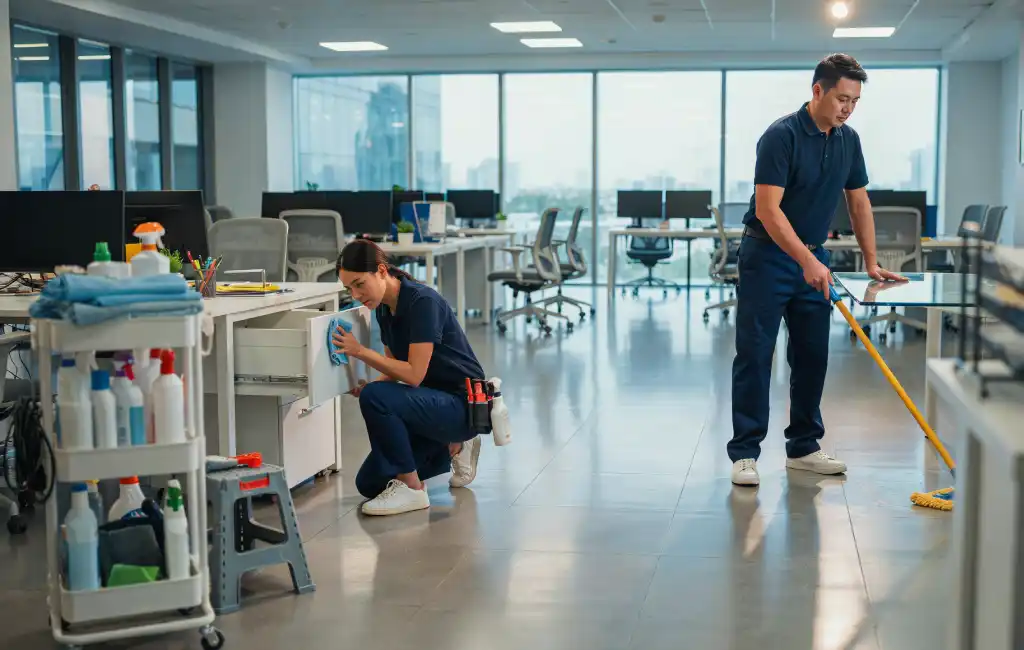
Dusting Air Vents and Hard-to-Reach Areas Is About Air Quality, Not Appearance
Weekly office dusting of air vents and HVAC return grilles is one of the most overlooked tasks in standard cleaning scopes, and one of the most consequential for employee health. Dust accumulation on these surfaces does not stay there. It circulates through the workspace with every cycle of your ventilation system.
Illinois winters generate significant particulate from tracked-in debris, road salt, and moisture, making vent and surface dust management more consequential seasonally than in many other climates. Employees who spend eight or more hours a day in the space are exposed to recirculated air quality across that entire period. Weekly dusting of hard-to-reach areas, including the top surfaces of cabinets, above-eye-level ledges, and lampshades, is a quality signal that separates thorough vendors from those who clean only what is visible at standing height. The EPA’s Indoor Air Quality resources connect dust and particulate management directly to occupant health outcomes in commercial buildings.
Why Illinois Businesses Trust Evergreen Cleaning Group With Their Commercial Facilities
If you have read this far, you already know what a complete commercial cleaning scope should look like. The next question is whether the company servicing your facility actually delivers it. Evergreen Cleaning Group was built for Illinois businesses that have had enough of vendors who show up, empty the trash, and call it done. We work with facility managers and office administrators who want a cleaning partner that documents its work, responds when something needs attention, and treats your facility the same way on visit fifty as it did on visit one.
| What We Offer | What It Means for You |
|---|---|
| Illinois-based local knowledge | We understand seasonal floor care demands, winter salt and debris patterns, and regional facility types, not a national template applied to your address |
| Customized service scope | Your cleaning plan reflects your facility’s actual layout, occupancy, and foot traffic, not a generic checklist handed to every client regardless of size or use |
| Consistent assigned cleaning teams | The same trained professionals service your facility on a recurring basis, so they know your space and you can hold them accountable by name |
| Transparent completion documentation | We support inspection logs and task records so your facility manager always has an audit trail, not just a verbal assurance that the work was done |
| EPA-approved cleaning and disinfection products | We use products appropriate to commercial environments and can document product use for clients with employee health or compliance requirements |
| Responsive to service concerns | We acknowledge reported issues within one business day and resolve them within the next scheduled visit, or sooner for urgent situations. |
- Evergreen Cleaning Group serves commercial clients across Illinois with service scopes built from facility walkthroughs, not pre-printed packages.
- Our recurring janitorial service model means your office is cleaned by a consistent team that knows your facility, your standards, and your priorities from one visit to the next.
- We treat a scope review as a service quality conversation, not a sales opportunity, which means we will tell you if your current plan needs adjustment before problems accumulate.
- Evergreen Cleaning Group brings Illinois-specific facility knowledge and a commitment to documented, accountable service to every client relationship.
FAQs
Q: What is the difference between daily janitorial service and a deep cleaning?
Daily janitorial service covers the recurring maintenance tasks that keep your office presentable and hygienic between visits: emptying trash, vacuuming high-traffic areas, wiping high-touch surfaces, sanitizing restrooms, and maintaining common areas. Deep cleaning goes further into areas that routine service does not reach on a regular basis, including the interior of appliances, grout lines, the undersides of furniture, interior window sills, and behind and beneath heavy equipment. Most Illinois commercial offices benefit from professional deep cleaning two to four times per year, with additional sessions after renovations, seasonal transitions, or extended office closures.
Q: How often should a professional cleaning service clean an Illinois office?
Most professional offices in Illinois require daily service for high-traffic zones and restrooms, with full-scope weekly service covering all workspaces, common areas, and floor surfaces. Frequency should increase with occupancy, client-facing activity, and seasonal factors such as Illinois winter months, when tracked-in salt, debris, and moisture create additional floor and entryway maintenance needs. Your cleaning vendor should recommend a frequency schedule after a walkthrough of your specific facility, not from a standard rate card.
Q: What areas are typically not included in standard commercial cleaning services?
Standard commercial cleaning generally excludes exterior window washing above ground level, power washing of building exteriors or parking areas, biohazard or hazardous material remediation, pest control, furniture or upholstery deep cleaning, and HVAC interior servicing. High-touch surface disinfection is sometimes listed as a standard inclusion and sometimes as an add-on depending on the vendor, so confirm it explicitly in your service agreement rather than assuming it is covered. Any task you rely on should be written into the scope, not inferred.
Q: How do I know if my office cleaning company is actually doing a good job?
The most reliable method combines completion documentation with periodic spot-checks: ask your vendor to provide daily or weekly task logs, then walk through restrooms, entryways, conference rooms, and high-touch surfaces twice a month using your contracted scope as a checklist. Pay attention to whether high-touch surfaces feel clean to the touch, whether restrooms are stocked consistently, and how quickly the vendor responds when you report a missed task. A vendor who resists documentation or is slow to respond to complaints is a vendor worth reconsidering.
Q: Are professional cleaning products safe for employees who work in the space after cleaning?
EPA-approved disinfectants applied to surfaces according to label directions are generally safe for occupancy once surfaces have dried, which typically takes 10 to 30 minutes depending on the product and ventilation conditions. If your office has employees with chemical sensitivities, asthma, or other respiratory considerations, ask your cleaning vendor to provide Safety Data Sheets for the products used in your facility. Low-VOC or green-certified product lines are available and appropriate for offices with these needs.
Conclusion
If you manage an Illinois office, you now have a complete picture of what a professional cleaning service should actually deliver and the tools to verify whether yours is delivering it.
A professional office cleaning service should follow a structured daily and weekly task framework covering restrooms, high-touch surfaces, common areas, floors, and workspaces, and that framework belongs in writing before any vendor relationship begins. Routine maintenance cleaning and periodic deep cleaning serve different purposes, and both belong in a complete facility management plan, particularly in Illinois where winter conditions make consistent floor and entryway care more consequential than in many other markets. Vendor accountability is not automatic: inspection logs, clear scope documentation, and defined response-time expectations are what separate a professional cleaning partnership from a contract that simply auto-renews every year.
A clean office is not a luxury. It is a direct investment in your employees’ health, your visitors’ first impression, and your facility’s long-term condition. You deserve a vendor who shows up prepared, documents the work, and communicates when something needs your attention.
Evergreen Cleaning Group serves commercial clients across Illinois and is ready to walk through your space and build a cleaning scope that reflects what your facility actually needs. Contact us at (847) 846-8695, reach us at info@evergreencleaninggroup.com, or request a free quote. Call today to schedule your no-obligation walkthrough and see what consistent, accountable office cleaning looks like in practice.