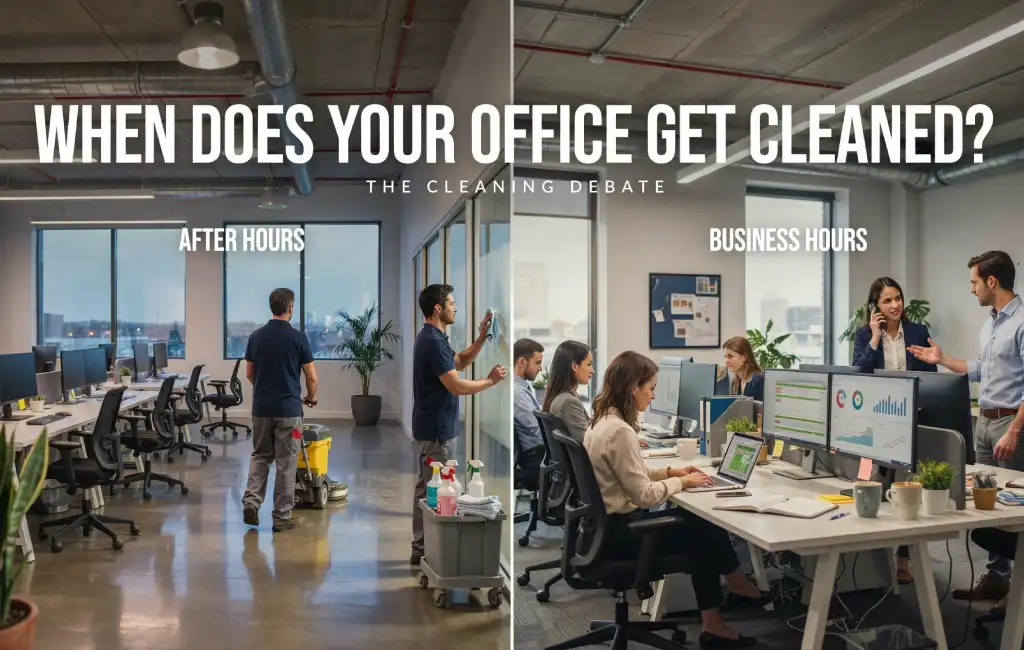
Your office gets cleaned every week. But have you ever stopped to ask whether it’s being cleaned at the right time?
For most Northbrook businesses, the answer to that question isn’t obvious. The right cleaning schedule depends on how your space is actually used, not on what your current provider defaulted to when you signed the contract. Office cleaning after hours vs. during business hours is a real operational decision with trade-offs on both sides, and the best choice for a medical suite on Skokie Valley Road looks nothing like the best choice for a corporate campus on Waukegan Road.
Evergreen Cleaning Group has helped Northbrook-area businesses work through exactly this decision, building cleaning schedules around how each office actually operates rather than applying a one-size-fits-all template. This guide gives you the same framework without the sales pitch.
Here is what this guide covers:
- The real difference between daytime cleaning, after-hours cleaning, and before-hours cleaning, and what each model actually involves on the ground
- What a day porter is, what they do during business hours, and when that staffing model is the right fit for your office
- The specific tasks that are better suited to nighttime deep cleaning, and why timing matters for things like carpet extraction after hours and floor polishing
- How a hybrid cleaning model combining day porter coverage with a night crew creates continuous maintenance rather than periodic intervention
- A practical framework for choosing the right schedule based on your industry, building type, foot traffic, and operational priorities
What Does “Office Cleaning Timing” Actually Mean for Your Business?
When a cleaning company asks whether you want daytime or after-hours service, they are asking a question that sounds simpler than it is. Before you can answer it well, you need a clear picture of what each scheduling model actually involves, because the terms get used interchangeably in ways that obscure real differences.
The three primary models are daytime cleaning, after-hours cleaning, and before-hours cleaning. Each one involves different access logistics, different task scopes, and different impacts on your staff and visitors. Understanding them as distinct options, rather than variations on the same thing, is the starting point for making a good scheduling decision. Comparing office cleaning services in Barrington for after-hours versus daytime schedules reveals that the best choice depends entirely on your facility’s traffic patterns, occupancy type, and specific operational needs rather than a one-size-fits-all approach.
| Schedule Type | When It Happens | What It Typically Includes |
|---|---|---|
| Daytime cleaning | During regular business hours | Real-time maintenance, restroom restocking, spill response, lobby upkeep, light surface cleaning |
| After-hours cleaning | After staff leave, typically 6:00 PM onward | Full-access deep cleaning, vacuuming, floor care, disinfection, carpet extraction, high-dusting |
| Before-hours cleaning | Early morning before staff arrive, typically 5:00 to 8:00 AM | Full cleaning pass with building access before the workday begins, no after-hours key management required |
Daytime Cleaning Is Not the Same as Having a Day Porter
This distinction matters more than most businesses realize. A daytime cleaning crew performing a full cleaning pass during business hours brings equipment into occupied spaces, creates noise disruption, and can create access conflicts when staff are actively using their workstations. That model works in some environments, but it is not what most people picture when they think of daytime cleaning.
A day porter services model is something different. A day porter is a dedicated on-site cleaner whose job is to maintain rather than deep-clean. Throughout the business day, they handle restroom restocking, immediate spill response, lobby upkeep, kitchen wipedowns, and trash management. They keep your office looking the way it did at 8:00 AM rather than letting it degrade until the next scheduled clean.
Understanding this distinction helps you ask the right question when talking to a cleaning provider. “Do you offer daytime cleaning?” and “Do you offer day porter coverage?” are not the same question, and the answer to one tells you nothing reliable about the other.
Before-Hours Cleaning Is a Third Option Most Businesses Overlook
Before-hours office cleaning typically runs from 5:00 to 8:00 AM, finishing before your staff arrive. It is the scheduling middle ground that most cleaning companies do not talk about, and most businesses have never been offered.
The practical advantage is straightforward. Before-hours cleaning eliminates the security complexity of true after-hours access, because your building management team or a designated employee can let the crew in at the start of the morning rather than coordinating alarm codes, key handoffs, and late-night access protocols. At the same time, it avoids any disruption to your working staff because the cleaning is finished before anyone sits down at their desk.
For Northbrook businesses that cannot manage after-hours access logistics but also cannot tolerate cleaning equipment moving through a working office, before-hours scheduling is often the practical solution that solves both problems at once.
What Are the Real Benefits of Daytime Cleaning for High-Traffic Offices?
The strongest argument for daytime cleaning is not convenience. It is continuity. In a high-traffic office environment, a spotless workspace at 8:00 AM does not stay that way through a full day of use without someone actively maintaining it. Benefits of daytime cleaning for high-traffic offices are most visible in the spaces that take the most abuse: lobbies, restrooms, kitchen areas, and shared conference rooms.
Daytime cleaning, particularly through a day porter model, keeps those spaces functional and presentable throughout the workday rather than recovering them overnight. For offices where client visits, patient appointments, or vendor meetings happen throughout the day, that ongoing maintenance directly affects the impression your space makes on people who matter to your business.
There is also a practical operational benefit that most businesses do not think about until they switch. When cleaning happens during regular operating hours, your building’s HVAC, lighting, and elevator systems are already running. After-hours cleaning in many commercial buildings requires those systems to stay on or be reactivated specifically for the cleaning crew, which can add to your utility load depending on your building management agreement. For businesses evaluating commercial cleaning service options, factoring utility costs into your scheduling decision reveals that daytime service may offer hidden savings beyond just labour rates and service frequency.
Key benefits of daytime cleaning at a glance:
- Real-time maintenance addresses spills, restroom issues, and lobby debris as they happen rather than hours later
- Restroom restocking during business hours ensures supplies are available when staff and visitors actually need them
- Immediate spill response reduces slip hazards and prevents stains from setting in high-traffic areas
- Visible cleaning activity communicates to employees and visitors that the workplace is actively maintained
- Daytime scheduling avoids after-hours access logistics entirely, simplifying security management
- Cleaning during operating hours means no additional utility load is created outside normal building systems
- A day porter presence allows flexible response to unpredictable traffic patterns rather than a fixed cleaning pass

Visible Cleanliness Affects Employee Morale and Visitor Perception
There is a difference between a workplace that was cleaned last night and a workplace that looks clean right now. For client-facing offices in Northbrook, that distinction is not subtle. A spotless lobby at 9:00 AM that has seen three hours of foot traffic by noon tells a different story than a lobby with someone actively maintaining it.
Research consistently links workplace cleanliness to employee satisfaction and perception of employer investment in their environment. Employees who work in visibly maintained offices report higher morale and a greater sense that leadership cares about their working conditions. That connection between visible hygiene culture and staff engagement is one reason day porter coverage is growing among corporate offices that have moved beyond treating cleaning as a pure cost item.
For offices in Northbrook with client-facing traffic that peaks unpredictably, the visible commitment to cleanliness that daytime maintenance provides is not cosmetic. It is a direct reflection of how your business presents itself to people who have not yet decided to trust you.
Daytime Cleaning Can Lower After-Hours Energy and Utility Costs
Most businesses do not think about cleaning schedules in the context of their energy costs. They should, at least at the level of asking the question.
When cleaning happens during regular operating hours, the building’s systems are already running. No additional HVAC activation, lighting extension, or elevator operation is required to support the cleaning crew. After-hours cleaning in many commercial buildings requires those systems to stay on, be scheduled to remain active, or be reactivated after the business day ends. Depending on your building management agreement and how your lease structures utility responsibilities, this can translate into a real cost difference.
For Northbrook corporate tenants with ESG reporting requirements or facilities cost-control mandates, the energy efficiency angle is worth raising explicitly with your cleaning provider and building manager. It is the kind of consideration a good cleaning partner should be able to help you think through, not something you should have to discover on your own.
What Are the Advantages of After-Hours and Nighttime Deep Cleaning?
The case for nighttime deep cleaning comes down to one thing that daytime cleaning cannot provide: full, uninterrupted access to every surface in your office. When staff are present, cleaning crews work around occupied desks, active equipment, personal items, and foot traffic patterns that make thorough cleaning difficult or impossible. After-hours cleaning removes all of those constraints.
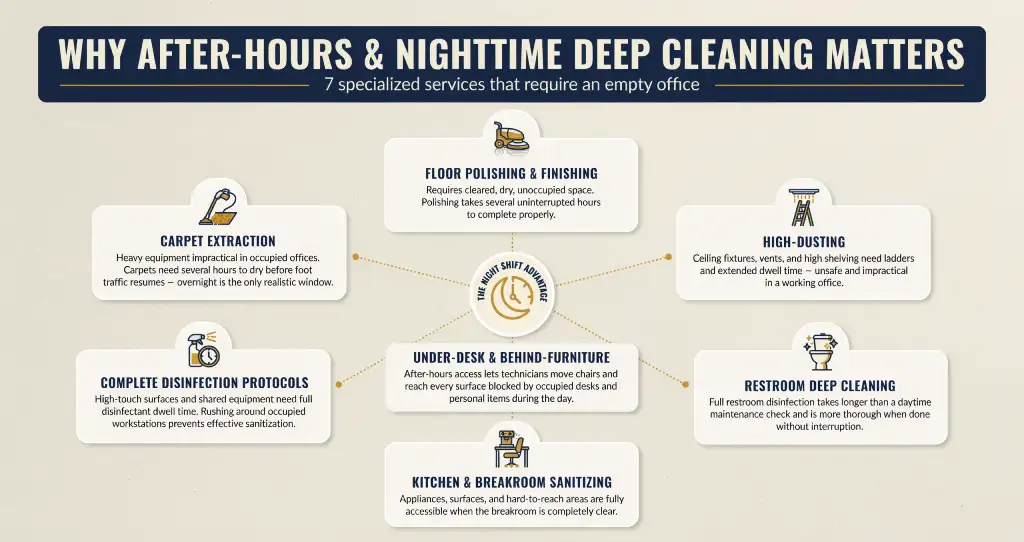
This is not a marginal difference. Tasks like carpet extraction, floor polishing, high-dusting, and complete disinfection protocols require clear, unoccupied space and time to complete properly. Trying to fit them into a daytime window around working staff is not a trade-off; it is a compromise that produces noticeably worse results. Advantages of nighttime deep cleaning services are most evident in the quality of the finished work, not just the scheduling convenience.
For Northbrook businesses managing larger office footprints, medical environments, or facilities where disinfection compliance is non-negotiable, after-hours access is frequently the only realistic path to the cleaning standard the space requires.
Tasks best performed after hours and why:
- Carpet extraction: Requires heavy equipment impractical in an occupied office, and carpets need several hours to dry before foot traffic resumes, making overnight timing the only realistic window. A comprehensive office cleaning service must account for these specialized tasks by scheduling carpet extraction during after-hours access when equipment can operate safely and carpets have adequate drying time before staff return the next morning.
- Floor polishing and floor finishing: Require cleared, dry, unoccupied space and typically take several hours to complete without interruption
- High-dusting: Accessing ceiling fixtures, vents, and high shelving requires ladders and extended dwell time that is unsafe and impractical in a working office
- Complete disinfection protocols: High-touch surfaces, shared equipment, and communal areas need full dwell time for disinfectants to work effectively, which rushing around occupied workstations prevents
- Under-desk and behind-furniture cleaning: After-hours access allows technicians to move chairs, access every surface, and clean areas that occupied desks and personal items block during the day
- Restroom deep cleaning: Full disinfection of restrooms takes longer than a daytime maintenance check and is more thorough when done without interruption
- Kitchen and breakroom sanitizing: Appliances, surfaces, and hard-to-reach areas are accessible when the space is completely clear
Full Area Access Allows Deeper, More Thorough Cleaning
Full access night cleaning is not simply a matter of convenience. When a cleaning crew can move through an entire office without working around occupied desks, blocked access points, and active workstations, the quality of the work changes fundamentally. Surfaces that are never touched during a daytime pass, the floor under a desk, the back of a credenza, the top of a partition wall, get cleaned on the same schedule as everything else.
Carpet extraction is the clearest example of why access timing matters. The equipment required for proper extraction is impractical in an occupied office under any circumstances, and once extraction is complete, the carpet needs several hours to dry before anyone walks on it again. Overnight timing is not just more convenient; it is the only way to do the job correctly. The same logic applies to floor polishing and floor finishing, both of which require cleared, dry, unoccupied space and time that a working office cannot provide. Understanding how much custodial services cost in Illinois helps facilities managers justify the investment in overnight deep cleaning cycles that deliver proper carpet extraction, floor finishing, and complete facility restoration rather than settling for compromised daytime maintenance.
The Institute of Inspection, Cleaning and Restoration Certification (IICRC) provides industry guidance on carpet extraction and floor care standards that illustrate why proper equipment use and drying time matter for both results and indoor air quality outcomes.
Overnight Cleaning Addresses Safety and Liability Concerns Daytime Cleaning Cannot
Wet floors in an occupied office are a slip-and-fall hazard and a potential liability exposure for building owners and tenants. OSHA 29 CFR 1910.22 requires that workplace walking-working surfaces be kept clean and in good condition, which applies to commercial offices in Illinois operating under federal OSHA jurisdiction for private employers.
When mopping, floor refinishing, or carpet extraction happens overnight, surfaces are fully dry before any employee or visitor enters the office the next morning. That is not a minor scheduling preference; it is a direct risk management outcome. Daytime mopping in a high-traffic office requires wet floor signs, restricted access, and active monitoring, all of which create disruption and still leave residual risk if a visitor rounds a corner before a floor is dry.
For Northbrook medical offices and professional services firms with consistent client-facing traffic, the liability angle of dry and safe floors is worth taking seriously as a scheduling factor, not just a cleaning consideration.
After-Hours Cleaning Supports OSHA Sanitation Standards Without Operational Trade-Offs
Maintaining compliance with OSHA 29 CFR 1910.22 general industry housekeeping standards requires more than a regular cleaning schedule. It requires that cleaning be thorough enough to actually keep walking-working surfaces clean and sanitation standards met consistently. In a high-traffic office, that standard is difficult to achieve when cleaning crews are working around occupied workstations and time constraints imposed by a working day.
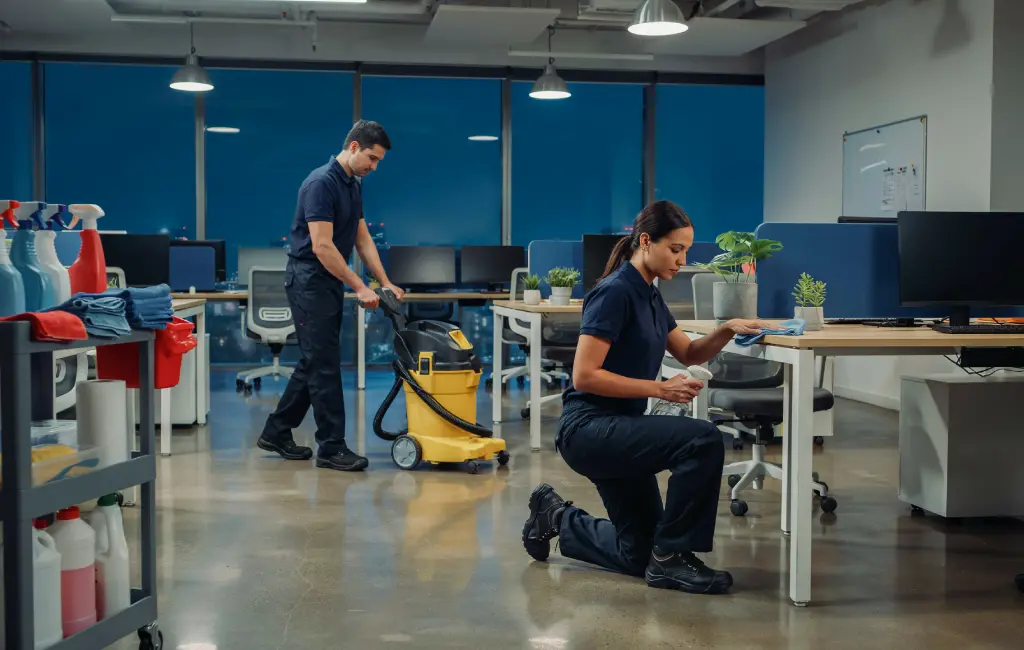
After-hours access allows cleaning crews to run complete disinfection protocols on high-touch surfaces, shared equipment, door handles, elevator buttons, and communal areas without rushing around occupied workstations or working in compressed time windows. The result is a more consistent compliance outcome, not just a cleaner appearance.
For medical facilities, dental practices, and outpatient clinics in Northbrook, disinfection protocol compliance is not optional and is not achievable in a compressed daytime window. After-hours or before-hours access is typically the only way to meet the standard comprehensively.
Why Northbrook Businesses Choose Evergreen Cleaning Group
Choosing a commercial cleaning partner is a real operational decision, and the right provider does more than show up with supplies. Evergreen Cleaning Group brings local market knowledge, documented security protocols, and a scheduling approach built around how your office actually works, making it a practical choice for Northbrook businesses that need more than a standard template.
| What We Offer | What It Means for You |
|---|---|
| Local Northbrook knowledge | We understand the commercial office environment along the Waukegan Road and Willow Road corridors, not just the cleaning industry in general |
| Customized schedule design | We assess your traffic patterns and operational needs before recommending a schedule, so you get a plan that fits your facility rather than a default package |
| Background-checked technicians | Every after-hours crew member is vetted before entering your building, giving businesses in medical, legal, and financial industries confidence in overnight access |
| Flexible hybrid scheduling | Day porter, night crew, before-hours, and weekend options are all available and can be combined into a single continuous coverage plan |
| Transparent access protocols | We handle key management, alarm codes, and access logs with clear documentation so you always know exactly how your building is being accessed and by whom |
| Cook County commercial experience | We serve Northbrook and the surrounding suburban corridor, which means local responsiveness and familiarity with the specific building management practices in this market |
- Evergreen Cleaning Group builds cleaning schedules around your operation, starting with a traffic pattern and facility assessment before any recommendation is made, so you are never paying for a schedule designed for a different kind of office.
- Our after-hours teams operate under documented access protocols covering background screening, key management, alarm code handling, and access logging, giving Northbrook businesses in sensitive industries a clear, verifiable answer to the security question before they ask it.
- We offer true hybrid scheduling that pairs day porter coverage with night crew deep cleaning, providing continuous maintenance from the first client arrival to the last task completed overnight, rather than a single daily intervention that can’t keep pace with a high-traffic office.
Frequently Asked Questions
Q: Is after-hours office cleaning more expensive than daytime cleaning?
Not necessarily. Cost depends on the scope of work, labor rates for evening shifts, and the logistics of building access, and while some cleaning providers do charge a modest premium for after-hours staffing, this is not universal across the industry. The more useful question is whether the tasks your office actually needs, such as carpet extraction, floor polishing, or complete disinfection, can realistically be performed during business hours without disrupting your staff, because if they cannot, the cost comparison becomes less relevant than getting the work done properly.
Q: What is a day porter, and does my Northbrook office need one?
A day porter is a dedicated on-site cleaning technician who maintains your office throughout business hours rather than performing a single full cleaning pass. Their work covers real-time tasks like restroom restocking, spill response, lobby upkeep, kitchen wipedowns, and trash management as the day progresses. If your office has consistent foot traffic, client-facing common areas, or shared spaces that visibly degrade between scheduled cleans, a day porter is worth evaluating as a complement to your night crew, not a replacement for one.
Q: How do I give my cleaning company after-hours access without compromising building security?
A reputable provider will have documented protocols covering exactly this, including background screening for all after-hours staff, a clear process for key handoffs and storage, secure handling and rotation of alarm codes, and maintained access logs. For Northbrook businesses in medical, financial, or legal industries, these are not optional considerations but reasonable baseline requirements that should be confirmed in writing before any after-hours work begins. If a cleaning provider cannot give you a specific, clear answer to each of those questions, that is itself useful information.
Q: Can I combine daytime and after-hours cleaning services?
Yes, and for many Northbrook offices a hybrid model is the most effective approach available. A typical hybrid plan pairs a day porter, who handles real-time maintenance during business hours, with a night crew that performs full-access deep cleaning after everyone has left. The right combination depends on your specific traffic patterns, facility type, and the tasks your office requires, and a cleaning provider should assess those factors before recommending any schedule rather than defaulting to a standard plan.
Q: How often should a Northbrook office be deep cleaned versus daily maintained?
For most professional offices, daily maintenance through a night crew or day porter handles surface-level cleanliness, while a more thorough deep clean covering carpet extraction, floor finishing, high-dusting, and complete disinfection is typically scheduled weekly, biweekly, or monthly depending on traffic volume and industry type. High-traffic offices and medical environments generally require more frequent deep cleaning cycles than low-traffic professional suites. A cleaning provider who has assessed your specific space can give you a more precise recommendation than any general guideline can.
Conclusion
Once you understand how your office is actually used, the cleaning schedule question stops being complicated and starts being a straightforward planning exercise.
There is no universally correct answer between daytime and after-hours cleaning. The right schedule depends on your foot traffic volume, facility type, security requirements, and the specific tasks your office needs performed on a regular basis. The day porter model and hybrid scheduling are significantly underused by Northbrook businesses that could benefit from continuous coverage rather than a single nightly clean. Before-hours cleaning, typically running from 5:00 to 8:00 AM, is a practical middle-ground option that eliminates after-hours access complexity while keeping your working day completely undisturbed.
The businesses that get this right are the ones that stopped treating cleaning as a fixed line item and started treating it as a service designed around how their office actually operates. If your current schedule was chosen by default rather than by design, that is worth reconsidering, and it is a straightforward conversation to have with the right partner.
Evergreen Cleaning Group serves Northbrook, IL and the surrounding Cook County commercial corridor. Contact us today to schedule a consultation for your office and get a cleaning schedule built around how your space actually works, not a template.